Clinical psychology, Santo Domingo
Your daughter started eating differently and you cannot tell if it is a phase or something serious.
Noticing is not overreacting. Eating disorders hide well, and they are almost always visible at home first, before they ever reach a consulting room.
I am María Laura Marranzini, a clinical psychologist. I work with eating disorders and obesity in Santo Domingo, in private practice, in English and Spanish.
What it looks like at home
The changes that matter rarely start with food. They start around food.
- She eats alone, or waits until everyone else has finished.
- She goes to the bathroom right after eating, repeatedly.
- She knows the calorie count of almost everything in the house.
- She has cut out whole food groups, for reasons that sound healthy.
- She changes clothes several times and ends up choosing the loosest thing.
- She trains even when she is ill, exhausted or injured.
- She talks about her body in a level of detail she did not use before.
Almost all of these can be normal. What changes them is the pattern.
A teenager can count calories because she trains, and wear loose clothes because it is the trend. One behavior on its own rarely means anything. These five are what make the difference.
- Rigidity
- Her rules about food cannot be broken. A change of plan, an invitation or a meal outside the usual hour produces distress out of proportion to the event.
- Secrecy
- The behavior is hidden, and the explanation changes depending on who asks.
- Escalation
- First one food went, then a whole group, and the list of what she does not eat keeps growing.
- Withdrawal
- She has started avoiding plans that involve food, even with people she likes.
- Duration
- Weeks or months of it, not a few days.
If you recognized a single behavior, and otherwise she eats, goes out and gets annoyed like anyone else when her plans change, you are more likely looking at a phase than a disorder.
If you recognized several, sustained over weeks, that warrants an assessment. What you are observing is information, not a verdict, and the assessment session exists for exactly that difference.
It happens to sons as well. It is caught later, because almost nobody is looking for it there.
Why it is not moving
Asking directly almost never opens the conversation.
The answer is usually “I am fine”, and that closes it. It is not necessarily a lie. In an eating disorder the behavior is experienced as control, and often it is the only thing that feels stable. Asking directly is asking her to hand that over before there is anything to replace it with.
What does open a conversation is naming what you see, without diagnosing and without talking about weight or food.
Closes it
“Are you eating?”
Opens it
“You have been quieter at the table lately.”
The question underneath
Guilt does not help you decide what to do.
Underneath all the other questions there is usually one, which is whether you caused this. It is not the question that helps, and it has no clean answer either. Eating disorders are multicausal. No family produces one on its own.
The family does have a role, and that role is the part that can be worked on. It is different from guilt, and it is far more useful.
Recovery holds or collapses depending on whether the family and the people around the patient are involved alongside them.
How I work
What happens after you write, in order.
The first session is an assessment
I listen to what you are seeing, ask concrete questions, and tell you whether what you describe warrants clinical attention. If it does not, I tell you that too.
Individual work, cognitive behavioral in orientation
I work on the behavior and on what holds it in place. When the case calls for it, I work with the family in parallel.
Psychological and psychometric assessment when the picture needs precision
Not to label, but to know what we are working with and to be able to measure whether anything is shifting.
If this is not what I do, I point you toward where to go
Some presentations need a different level of care, or a medical team first. Saying so early is part of the work.
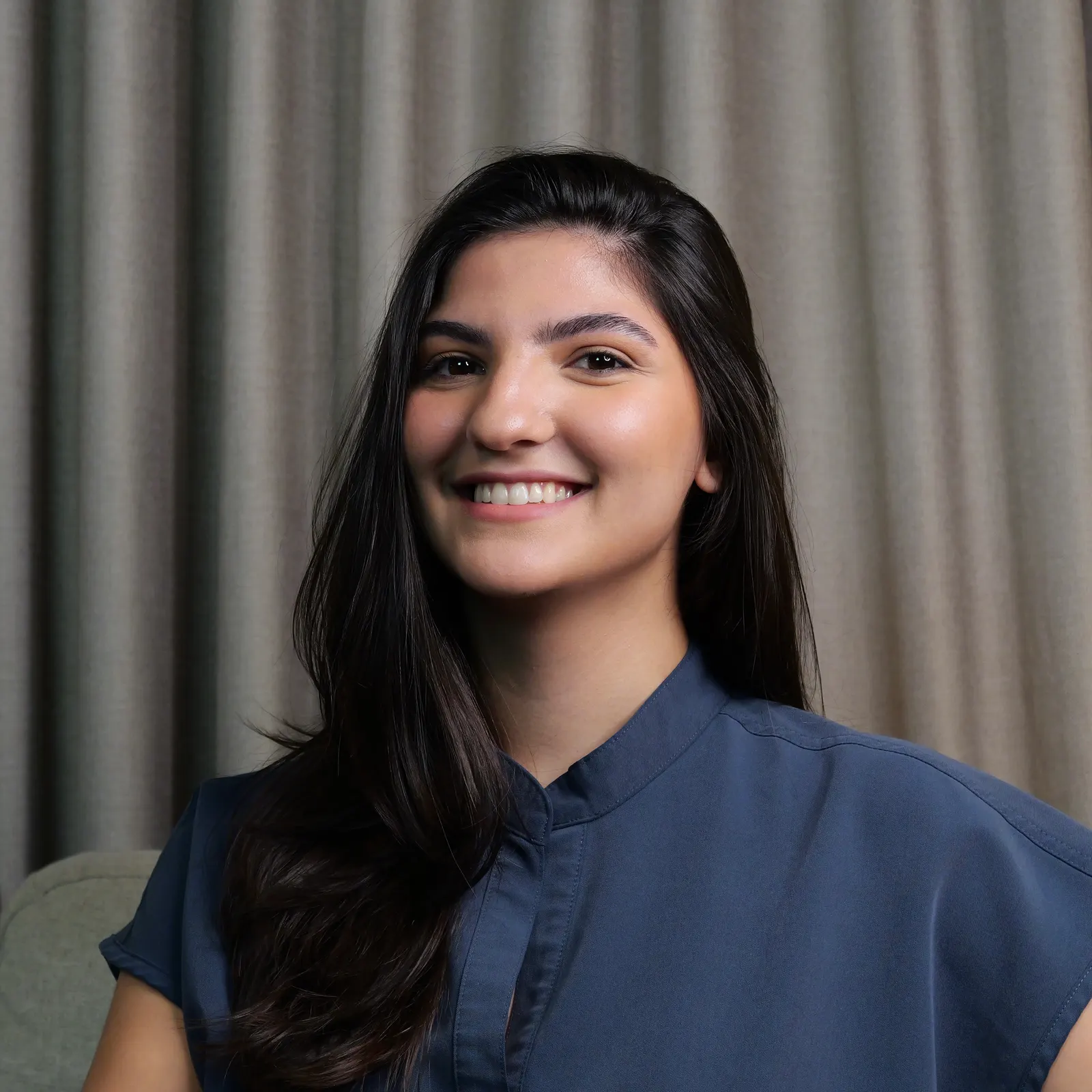
María Laura Marranzini Rizek, M.A.
Training
Where I trained, and what licenses me to do this.
- Licence
- Licensed Clinical Psychologist, Dominican Republic. Exequátur, Executive Decree No. 119-24, registry 44138, Ministry of Public Health, February 2024.
- Master
- Master's degree in Eating Disorders and Obesity, European University of Madrid, 2022 to 2023. Includes 300 hours of supervised clinical practicum.
- Degree
- Bachelor's degree in Clinical Psychology, Universidad Iberoamericana (UNIBE), 2017 to 2020.
- Practicum
- Niño Jesús Children's University Hospital and Santa Cristina University Hospital, Madrid, 2023. Both are national reference centers for eating disorders in Spain.
- Practice
- MIITRAL, Centro de Cardiología Integral. Santo Domingo, since 2024.Centro de Gastroenterología Avanzada (CGA). Santo Domingo, since 2025.These are two separate and independent practices.
Scope
Who this is for, and what I do not do.
Book a session if
- You suspect an eating disorder in your daughter or your son.
- You are on GLP-1 treatment and your relationship with food has become harder, not easier.
- You have been asked for a psychological assessment before bariatric surgery.
- You eat to regulate what you feel and you want to understand the mechanism.
- You lost weight and the image you have of your body got worse.
What I do not do
- I do not prescribe or adjust medication. That conversation is with your treating physician.
- I do not diagnose without an assessment, by email or by phone.
- I do not design meal plans. When one is needed I point you toward nutrition and work in parallel with whoever leads it.
- I am licensed in the Dominican Republic and not in the United States, so I cannot provide therapy to anyone located there.
- This site is informational and does not replace clinical evaluation.
What falls outside my scope does not get left hanging. I work inside medical practices, and part of the first session is working out what you need and who else should be involved.
Other reasons people come
For families
What to look at, what to say and what is better left unsaid while you work out whether this is serious.
GLP-1 treatment
GLP-1s are legitimate treatments with a psychological dimension almost nobody is attending to. The support runs alongside the medical treatment.
Articles
Types of hunger, emotional eating, body image and the inner voice around food.
Getting started
Booking takes one message.
Times are arranged over WhatsApp. You do not need to explain anything there, or know whether it is serious. That belongs in the first session, which is where it is protected.
Message on WhatsApp(809) 393-0421
You can also write to psic.lali.tca@gmail.com. It works just as well for booking, though it takes a little longer.